How to Build a Medical Practice Operating System (Reduce Operational Chaos)
Jun 12, 2026
A doctor called me not long ago, and I could hear the exhaustion in his voice before he even got to the point.
His practice manager had left unexpectedly due to a medical emergency. There was no notice, no transition plan, and no documentation of anything she managed. Within days, it became clear that the practice had not lost just an employee. It had lost its institutional memory.
She was the only super user admin in the EMR. That meant no one could add a new user, reset a password, or change access levels. The PECOS login for Medicare revalidation existed somewhere, but no one knew where, and the revalidation window was days away. The payroll system required two-factor authentication tied to her personal cell phone. The McKesson medical supplies account was locked. The malpractice certificate of insurance could not be located. A payer needed a current W-9, and nobody could find the last one on file.
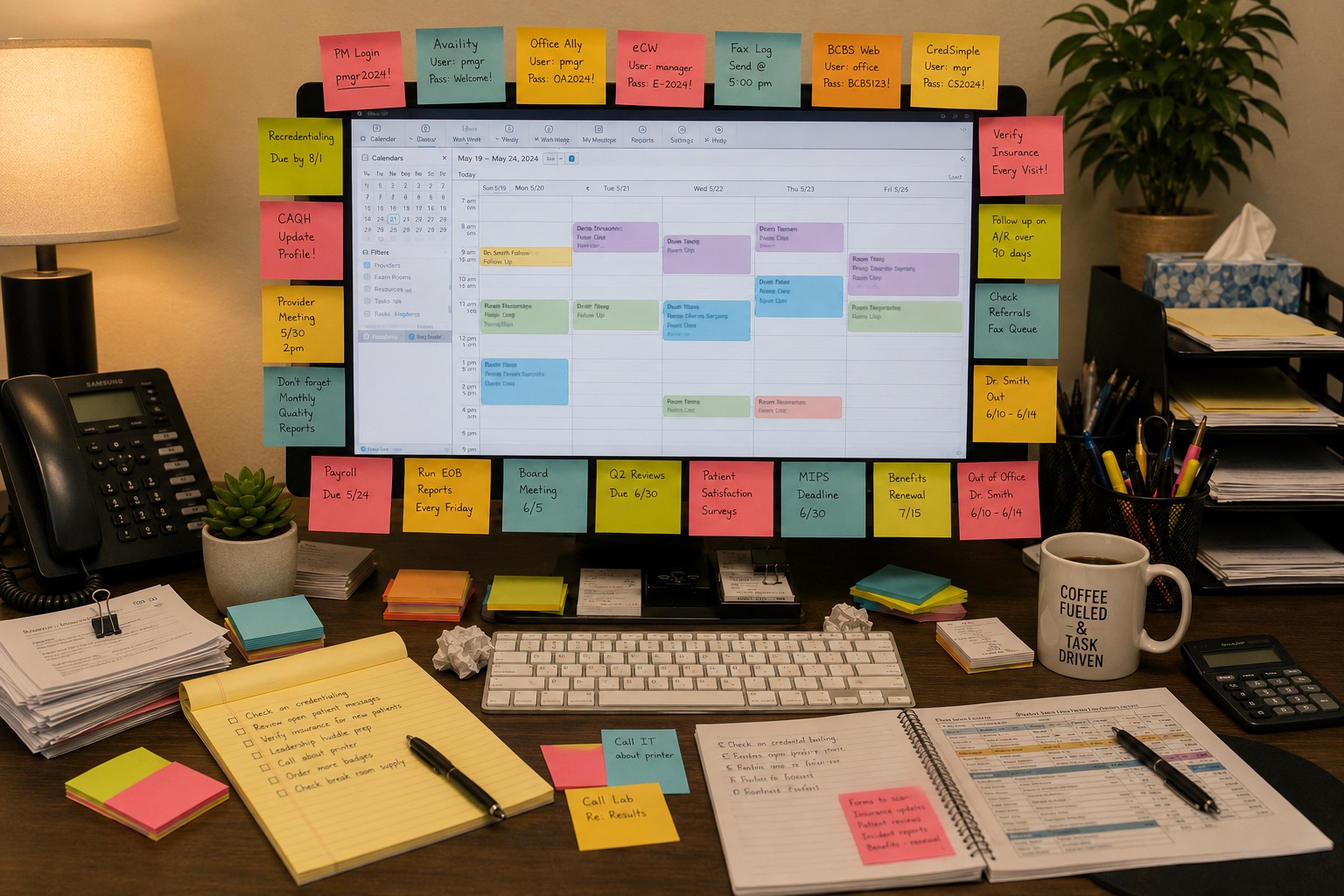
Everything that had felt manageable when she was there suddenly felt impossible. Not because the team was incapable, but because too much had lived in one person's head, on sticky notes around one monitor, and scattered across email threads no one else could search.
This is what I call the single failure path. One person holds the keys to the castle. And when that person is gone, whether it is a planned departure, a sudden illness, or a family emergency, the entire practice pays the price.
I want to be clear about something. The person who holds all that information is usually one of the most dedicated people in the practice. She was not trying to create a problem. She was trying to keep everything running. The real issue is that the practice never built enough structure around her.
I see this more than you might expect. And it is not a sign of poor leadership. It is a sign of how most practices were built: by capable, committed people who never had the time or the tools to document what they knew.
The Practice Needs a Brain, Not a Person
Inside Medical Practice Mastery, one of the first things we build together is what I call the practice operating system. It is not complicated software. It is a secure, central, organized, collaborative place where the business side of the practice is documented and accessible to the right people at any time. We build it in Trello, and the first time a client sees it fully built out, the reaction is almost always the same.
"Did you build this?"
Yes. And now it belongs to them.
The first time a practice sees this kind of structure in place, the reaction is usually a mix of relief and disbelief. Not because it is complicated, but because so much of what they have been chasing, recreating, or trying to remember finally lives in one organized place
It starts with the core details of the practice: entity information, locations, provider records, key documents, vendor contacts, and the operational information the team depends on every week. From there, it becomes the place where leadership can track important deadlines, recurring responsibilities, meeting notes, and the details that are easy to lose when they live in someone’s inbox or memory.
The goal is not to document every tiny thing just for the sake of documentation. The goal is to make sure the right people can find the right information when they need it.
When this is in place, a new practice manager can get up to speed faster. A Medicare revalidation deadline does not sneak up on anyone. When an employee leaves, there is a clear process for removing access. When a payer asks for a document, someone knows where to find it.
That is the difference between a practice that is dependent on one person and a practice that is supported by a real operating system.
You Are Building This for Your Future Self
Most of the operational chaos I see inside practices is not really a people problem. It is a structure problem. When critical information lives in someone’s memory, on a handwritten note, or buried in an old email chain, that information is not truly available to the practice. It is just stored somewhere only one person can use it.
Building a practice operating system is an investment. It takes time, and it takes intention. But the return is real. Future you will not spend an hour trying to track down a DEA certificate before a credentialing deadline. Future you will not be on hold with a payer because no one can locate the fee schedule. Future you will not be locked out of payroll on a Friday afternoon because the person who knew the login is no longer there.
This is not about being overly cautious or preparing for disaster. It is about running a well-organized practice. And well-organized practices are more profitable, more resilient, and far less exhausting to lead day to day.
A Note to the Managers Reading This
I say this with genuine warmth, because I have sat in your chair: the sticky notes have to go.
I know exactly how they get there. You are the person everyone comes to, and over time you become the unofficial keeper of everything. It feels practical to have reminders in front of you. But what it actually creates is a system that only works when you are in the room, and that puts enormous pressure on you.
You deserve infrastructure that supports you, not one that depends entirely on you. When the knowledge lives in the system instead of in your head, you become easier to support, easier to develop, and much easier to cover when you are out. That is not a loss of value. That is what a well-led practice looks like.
When the Practice Is Organized, You Can Focus on What Actually Matters
The practices that run with the least chaos are not always the largest or the most resourced. They are the ones where the right information is available to the right people at the right time. That kind of organizational clarity does not happen by accident. It is built intentionally, with the right structure in place.
That clarity creates calm. And calm is where excellent patient care happens. It is where revenue grows. It is where your team does its best work and stays long enough to make a real difference.
If this is an area where your practice needs attention, I would be glad to talk through what building that structure could look like for you. Inside Medical Practice Mastery, this is the foundational work that changes how everything else in the practice operates.
Let's Talk About What This Could Look Like for Your Practice
If your practice is overly dependent on one person’s memory, or if you have never had a central place for your operational information, that is exactly where we start in Medical Practice Mastery. The result is a more organized, more resilient, and more profitable practice.
Book a complimentary consulting call and let's explore what is possible for your practice.