How Medical Practice Leaders Prioritize Decisions (Eisenhower Matrix)
Apr 17, 2026
When the Loudest Thing Gets the Most Attention
Here is something I watched happen in real time this week.
A client of mine is navigating a significant drop in revenue. One of their physicians departed, and the practice is actively working to stabilize patient volume, protect collections, and plan for what comes next. The stakes are real. The pressure is high.
And in the middle of all of that, the owner pulled the team together to explore switching office supply vendors.
No urgent need. No vendor failure. No compelling financial case. A sales rep had gotten in front of the right person at exactly the wrong moment, and suddenly the team's attention and energy shifted toward evaluating supply contracts.
I asked one simple question:
Is this what your practice needs to be focused on right now?
The answer was obvious. But sometimes, in the chaos, we need someone to ask it out loud.
Why This Happens
Medical practice leaders are responsible for an enormous number of decisions every week. Clinical decisions, operational decisions, personnel decisions, financial decisions, and patient experience decisions. The list does not stop.
When a practice is already under pressure, two things tend to happen. The first is reactive decision-making, where whatever feels most immediate gets treated as most important. The second is the "shiny distraction," where a new idea, a vendor pitch, or a well-timed conversation introduces something that feels productive but doesn't actually move the needle.
Neither of these is a leadership failure. They are completely human. But they are expensive when your practice cannot afford to lose focus.
The good news is that there is a straightforward tool that helps with this.
Where This Framework Comes From
Dwight D. Eisenhower, the 34th U.S. President and Supreme Allied Commander in World War II, was legendary for making high-stakes decisions under extraordinary pressure without losing strategic clarity. He is credited with the observation that urgent matters are rarely important, and important matters are rarely urgent.
That insight became the foundation of what we now call the Eisenhower Matrix. It was later formalized and popularized by Stephen Covey in The 7 Habits of Highly Effective People, where he described it as the key to effective time and priority management.
The framework has endured for decades because the problem it solves is timeless: when everything feels pressing, how do you decide what actually deserves your attention right now?
Why this translates directly to medical practice management:
Practice leaders face a uniquely relentless decision environment. Clinical urgency bleeds into operational urgency. Vendor reps, staff issues, patient complaints, and revenue pressures all arrive at the same time and all feel pressing. Without a filter, leaders default to whatever is loudest, which is almost never the same as whatever is most strategic.
The most dangerous quadrant in a busy practice is the bottom left: tasks that feel urgent but are not truly important. These consume physician owners and administrators and create the illusion of productivity while the real strategic work waits.
The Eisenhower Matrix, Applied to Your Practice
The framework sorts every decision through two questions:
Is this important? Is this urgent?
Where a task lands inside that grid tells you exactly what to do with it.
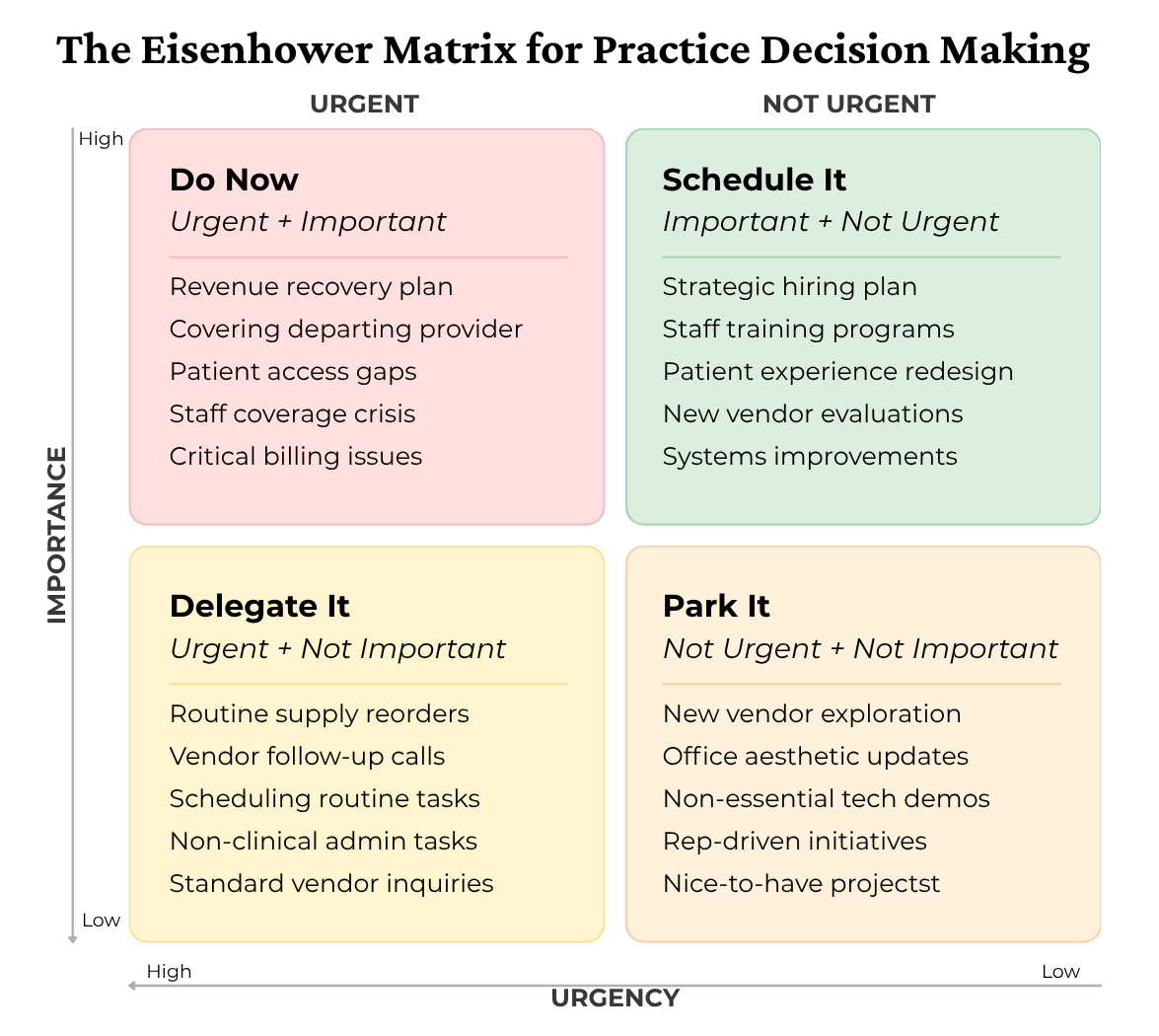
🔴 Do Now (top left): Urgent and important. This is where your departing physician situation belongs. Revenue recovery, patient access, coverage planning. These belong at the top of your list with your full attention and resources.
🟢 Schedule It (top right): Important but not urgent. These are the strategic moves that build a stronger practice over time. Staff training, hiring plans, process redesign. They matter deeply, but they have room to breathe. Put them on the calendar before they become urgent.
🟡 Delegate It (bottom left): Urgent but not important. These need to happen, but they do not require the physician-owner or practice administrator to handle them personally. Routine tasks, standard follow-ups, and administrative coordination. Get them off your plate and into the right hands.
🟠 Park It (bottom right): Not urgent and not important. This is where that office supply vendor conversation belongs. It might be worth revisiting someday when the practice has margin and bandwidth. But right now, it belongs in the parking lot, not in a team meeting.
A note on the "Parking Lot"
I use this term intentionally with my clients. Not everything that lands in the low-priority quadrant needs to be refused outright. Some ideas genuinely deserve a second look when the timing is right. The parking lot is where you put good ideas with bad timing. You can always go back for them.
What My Client Did
Once we walked through the matrix together, the decision was clear. The office supply vendor conversation was parked. The team refocused. The energy that would have gone into comparison spreadsheets and rep negotiations went back into the revenue recovery plan, where it belonged.
No harm done. But also no wasted time.
That is what a simple framework can do. It does not make the decision for you. It just makes the right answer impossible to ignore.
A Quick Way to Use This Starting Today
The next time something lands on your desk and demands attention, run it through these four questions before you commit:
- Is this urgent for my practice right now?
- Is this important for my practice right now?
- Who actually needs to handle this?
- Is now the right time, or should this go in the parking lot?
You do not need a retreat or a strategic planning session to use this. You need ten seconds and the willingness to be honest about where your attention is most needed.
The practices that operate with calm and consistency are not the ones that never face chaos. They are the ones who have learned how to sort it.
My client told me afterward that it felt like a no-brainer once we looked at it together. And that is usually how it goes. Most of the time, leaders already know the right answer. They just need something to help them see it clearly in the moment.
If your practice is carrying decisions, distractions, or competing priorities that feel hard to sort through right now, that is exactly the kind of conversation I love to have.
Ready to bring clarity to what your practice is navigating?
Book a call with me here and let's sort through the priorities together.