How to De-Escalate Angry Patients in Medical Practices (What to Say First)
May 01, 2026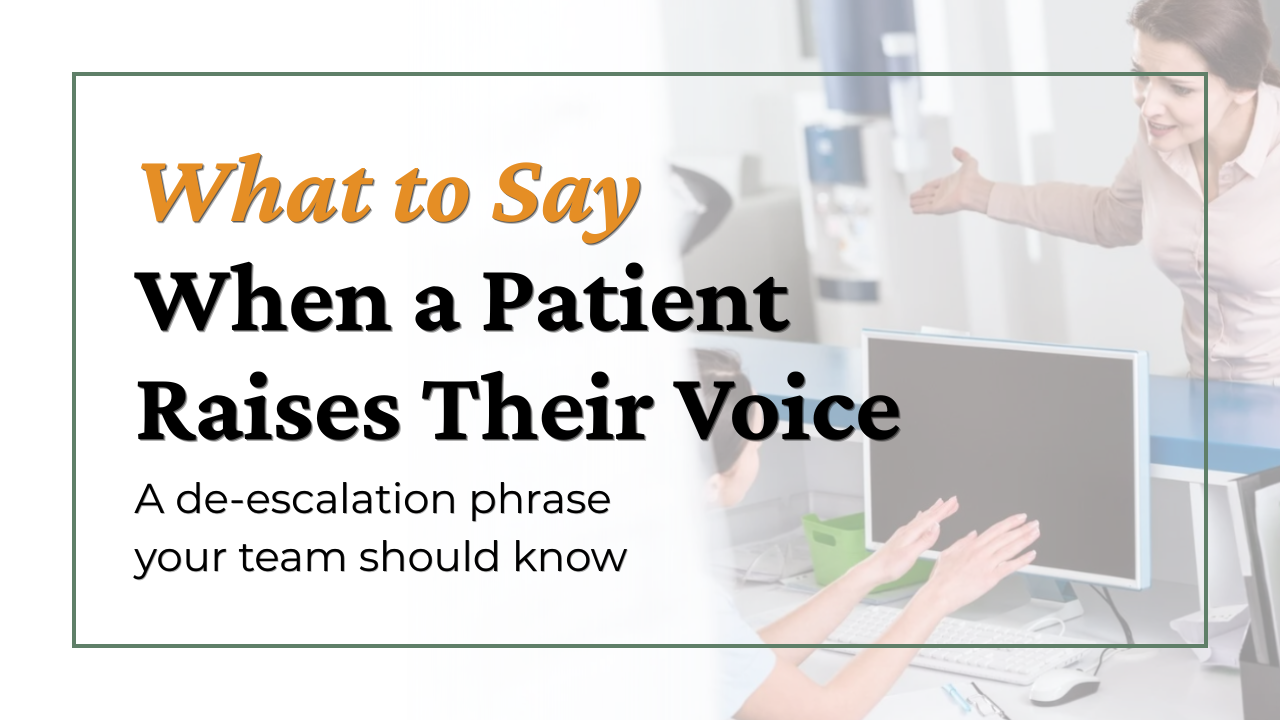
When a patient raises their voice, what your team says next matters more than you think
Every practice deals with it. A patient walks up to the front desk frustrated or calls in upset, and their voice goes up. Maybe they waited too long. Maybe a referral fell through. Maybe they were billed for something they did not expect.
Whatever the reason, the next ten seconds will decide how the rest of that interaction goes. And in most practices, the team has never been taught what to actually say.
The two instincts that make it worse
When a patient raises their voice, most staff members default to one of two reactions.
The first is to shut it down. Some version of, "There is no reason to yell," or, "Please lower your voice." Even said calmly, this puts the patient on defense. Now they are not just upset about the original problem. They are upset that they were corrected. You just added a second issue on top of the first one.
The second is to over-apologize. Staff members start absorbing blame for things they did not do, agreeing with everything, promising fixes they cannot deliver. This feels like de-escalation in the moment, but it usually creates a bigger problem on the back end when the patient expects something the practice cannot follow through on.
Both reactions come from the same place. The team member is uncomfortable, and they want the discomfort to stop. That is human. But it does not serve the patient, and it does not protect the practice.
What actually works
There is a better response, and it is simple enough that any team member can use it.
"I want to help. Let's slow this down so I can fully understand."
That sentence does three things at once. It signals that you are on the patient's side. It buys a few seconds to reset the pace of the conversation. And it shifts the dynamic from conflict to collaboration without agreeing to anything you cannot deliver.
The patient does not actually want to yell. They want to feel like someone is paying attention and is going to help solve their problem. When you give them that, the volume comes down on its own.
I walk through this in more detail in a short video, including why this phrase works and how to coach your team to use it consistently.
🎥 Watch: What to say when a patient raises their voice

Why does this belong in your training, not just in the moment
A team that only handles upset patients well when the right person happens to be at the front desk is a team that has not been trained. It has gotten lucky.
Consistency is what separates a practice that handles tension well from one that creates more of it. When every team member knows the same opening response, you stop relying on personality and start relying on a system. That is how you protect the patient experience even on hard days.
If your front desk or phone team has never been formally trained on de-escalation, that is one of the highest-leverage gaps you can close this quarter. Most patient complaints that reach the practice owner started as a moment that could have gone differently with one better sentence.
Want a short de-escalation training for your front desk and phone team? Learn more here.